Pete explains why you're reading his nonsense words instead of listening to them
Its fair to say that DNSYE has not stood still since it’s conception during the pandemic. The underlying ethos of the whole thing at the start and still is:
DROP IMAGE / QUOTE AFTER THIS PARAGRAPH
• Have fun creating Watford FC related content • Do things in a way that others are not doing • Involve the Watford FC fan base as much as possible • Be open to other opinions (we don’t see the game the same)
DROP IMAGE / QUOTE AFTER THIS PARAGRAPH
↕ DRAG IMAGE
No caption
So here we are launching PREVIEW. There are no match programmes anymore (other than bespoke souvenir editions ordered online after the event), there are currently no fanzines running and there is a dearth of written word pieces that don’t sit behind a paywall.
DROP IMAGE / QUOTE AFTER THIS PARAGRAPH
Well, being a podcast that has been described as the “fanzine” podcast we thought – why not reverse engineer the whole thing and provide something on a regular basis that could act as a “preview” of the forthcoming game(s), a “review” of the recent games and events at Vicarage Road? Yes it will be electronic in nature (“e-view”) and finally we would welcome your participation however much or little you might like to get involved after all DSNYE is as much about your “view” as ours. But it’s us so it will be unrelentingly crap.
DROP IMAGE / QUOTE AFTER THIS PARAGRAPH
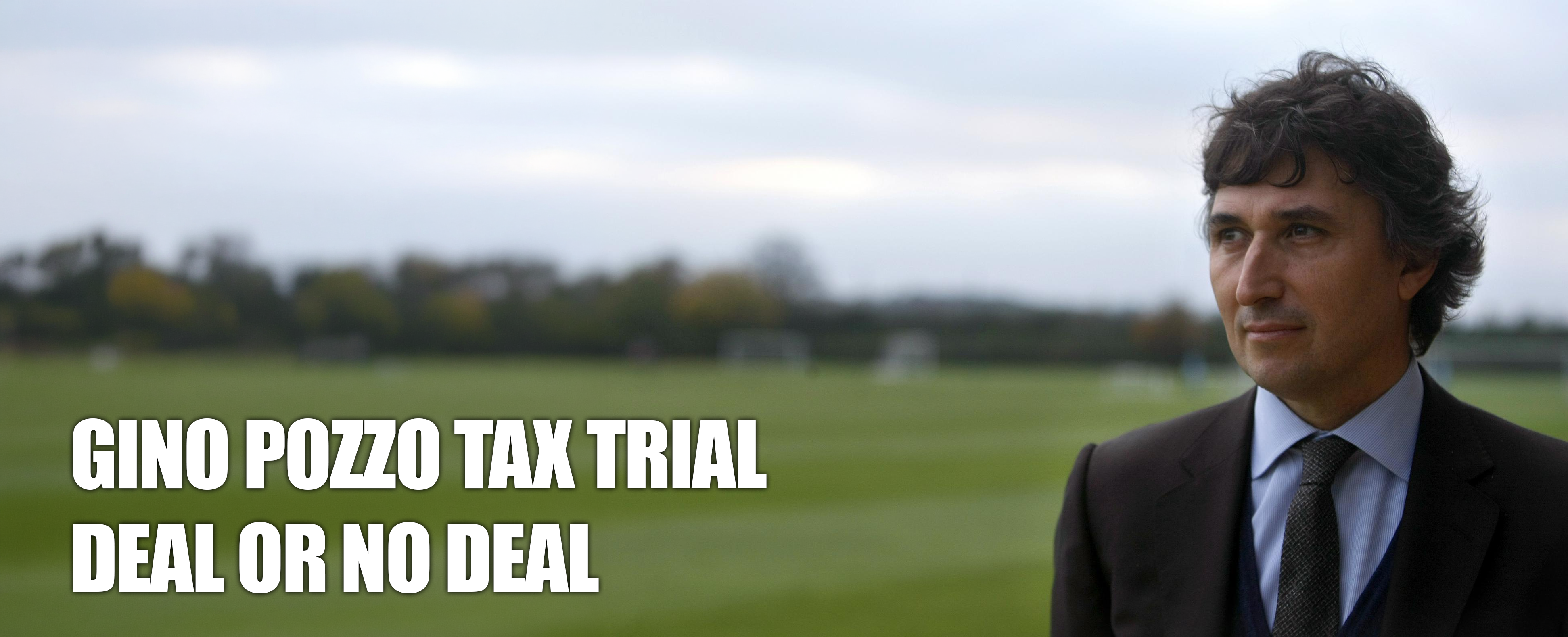
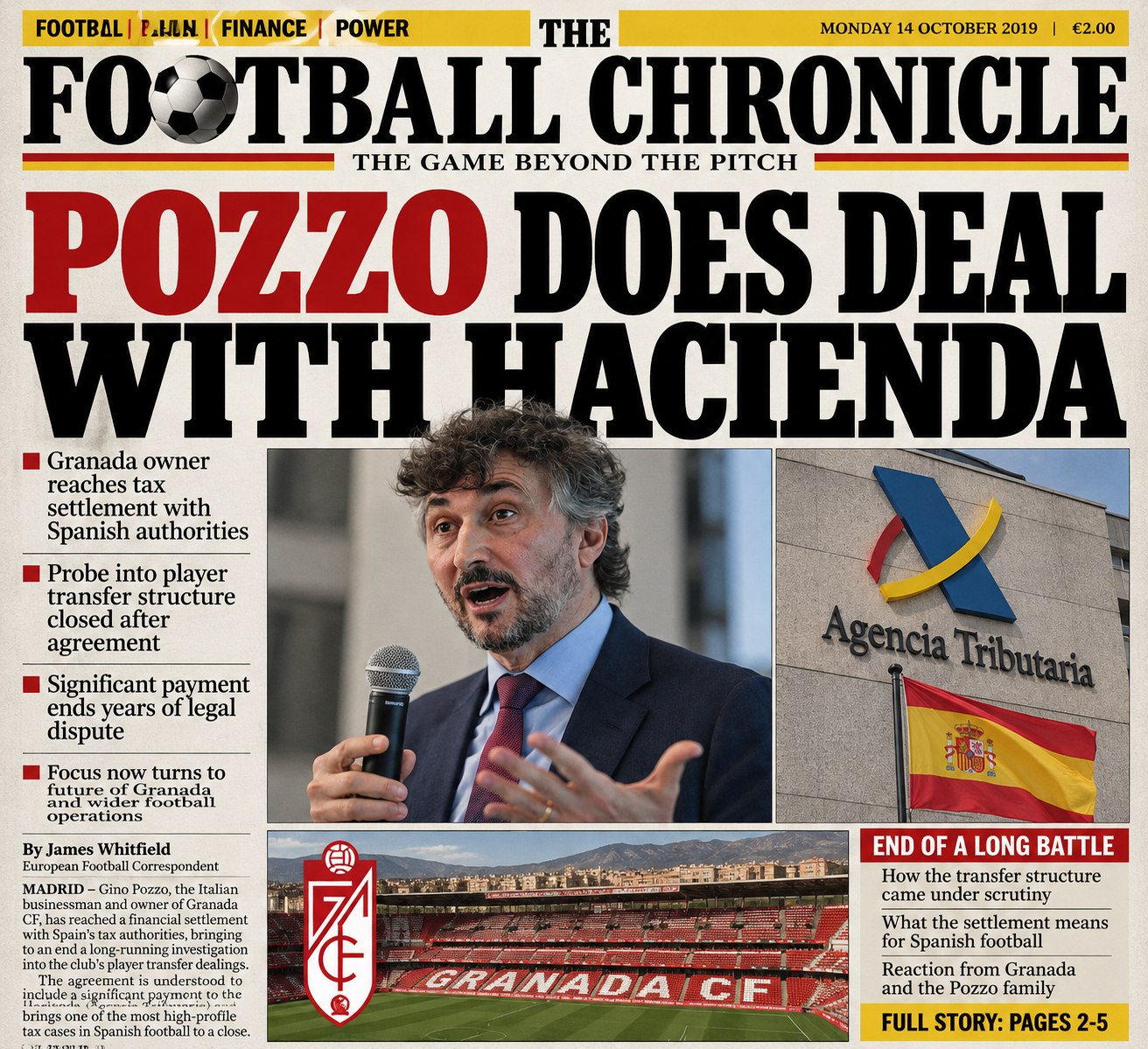
Here is the pilot issue where we take on quite a mammoth task. We try to give you an insight into the forthcoming trial of Gino Pozzo in the Spanish Tax courts (Hacienda) – a lot of misunderstanding has been seen online recently, and we hope we can bring andundoubtedly dry subject to life. Does the “house” always win and is it deal or no deal?
DROP IMAGE / QUOTE AFTER THIS PARAGRAPH
We hope you like our new direction (pun intended) but don't worry the usual rubbish audio and video will still come at you like a torrent!!
The €9.4 Million Question: What Is Gino Pozzo Actually Accused Of?
On 9 November, Watford owner Gino Pozzo is scheduled to stand trial in Spain's Audiencia Nacional over allegations arising from his family's period controlling Granada CF.
DROP IMAGE / QUOTE AFTER THIS PARAGRAPH
The headline is dramatic.
DROP IMAGE / QUOTE AFTER THIS PARAGRAPH
↕ DRAG IMAGE
GRANADA CF
Spanish prosecutors are seeking 12 years in prison over three alleged aggravated corporation-tax offences concerning 2013, 2014 and 2015.
DROP IMAGE / QUOTE AFTER THIS PARAGRAPH
But before asking whether Pozzo might be convicted, imprisoned or ultimately reach some form of agreement with prosecutors, there is a more fundamental question.
DROP IMAGE / QUOTE AFTER THIS PARAGRAPH
What is the argument actually about?
DROP IMAGE / QUOTE AFTER THIS PARAGRAPH
Because this isn't simply a case in which everybody agrees Granada failed to pay €9.44m of tax and the court now has to decide the punishment. The defence disputes the underlying proposition that Granada owed that tax in the first place.
DROP IMAGE / QUOTE AFTER THIS PARAGRAPH
The prosecution case
DROP IMAGE / QUOTE AFTER THIS PARAGRAPH
The alleged unpaid corporation tax is: 2013 — €635,000.01 2014 — €5,914,679.10 2015 — €2,892,218.00 Approximately €9.44m in total.
DROP IMAGE / QUOTE AFTER THIS PARAGRAPH
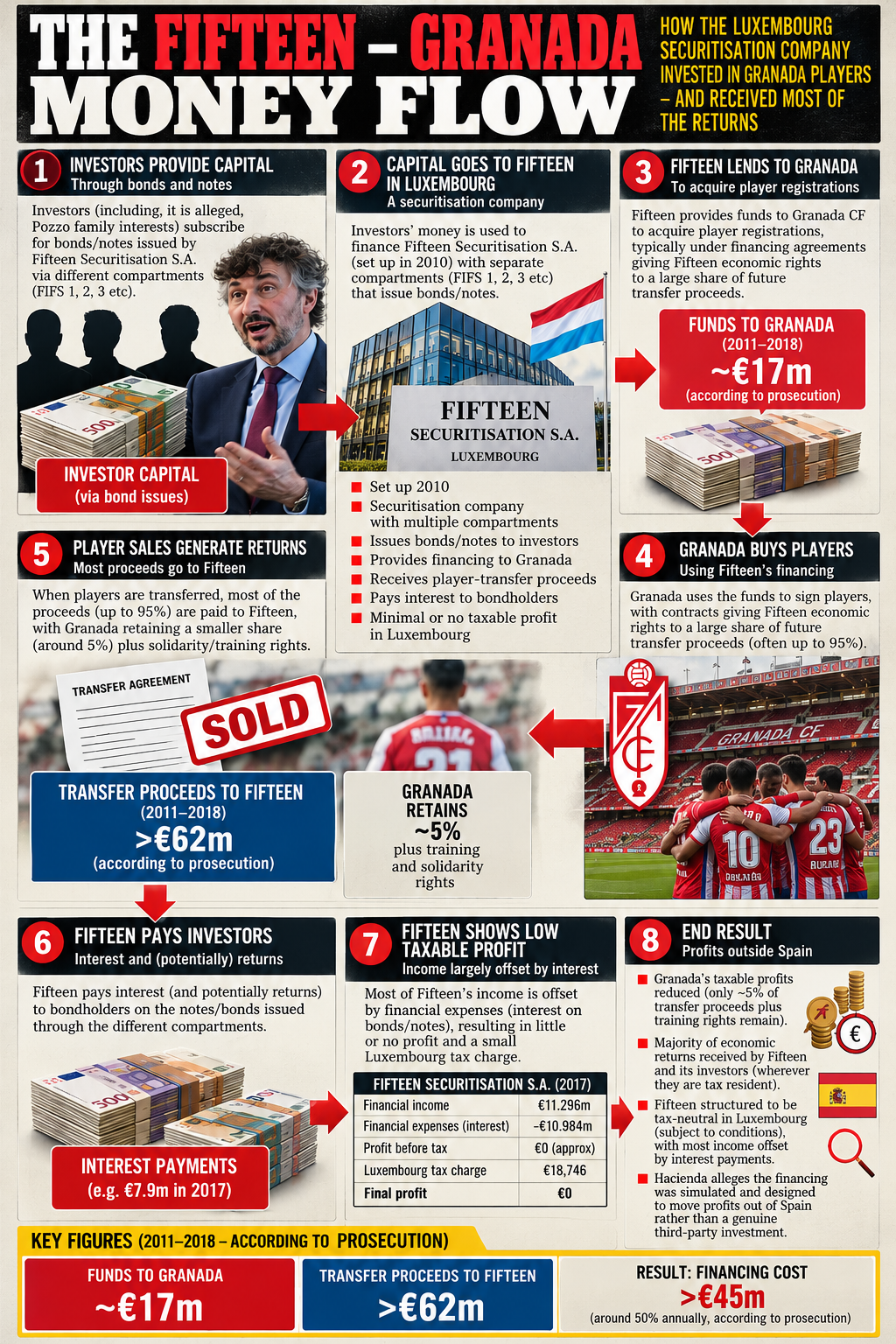
At the centre of the case is Luxembourg-based Fifteen Securitisation SA.
DROP IMAGE / QUOTE AFTER THIS PARAGRAPH
Fifteen provided money which enabled Granada to acquire players. In return it obtained very substantial economic interests in the proceeds if those players were subsequently transferred — reportedly as much as 95% in some arrangements.
DROP IMAGE / QUOTE AFTER THIS PARAGRAPH
The prosecution's contention is essentially that this was simulated financing.
DROP IMAGE / QUOTE AFTER THIS PARAGRAPH
On its interpretation, Granada generated the economic profits when players were subsequently sold, but the structure allowed most of those profits to be diverted to Luxembourg rather than appearing as taxable Granada profits in Spain.
DROP IMAGE / QUOTE AFTER THIS PARAGRAPH
Investigators have pointed to the economics of the arrangement. Approximately €17m was reportedly advanced by Fifteen between 2011 and 2018 while more than €62m subsequently flowed back, producing what prosecutors regard as an extraordinary effective cost of financing.
DROP IMAGE / QUOTE AFTER THIS PARAGRAPH
The prosecution therefore sees an artificial mechanism through which Granada's profits were moved outside Spain.
DROP IMAGE / QUOTE AFTER THIS PARAGRAPH
The defence sees something completely different
DROP IMAGE / QUOTE AFTER THIS PARAGRAPH
↕ DRAG IMAGE
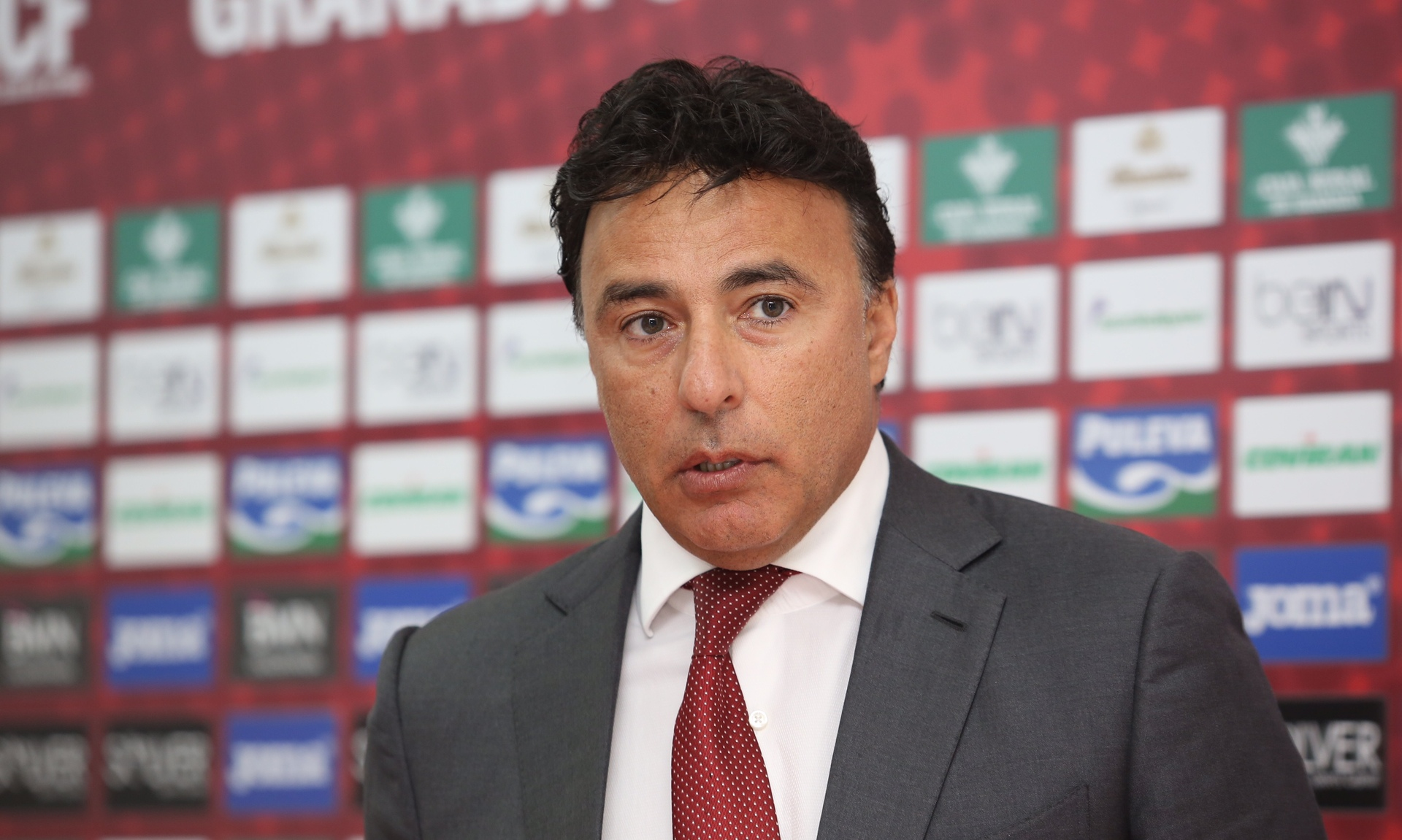
Rafaele Riva
Raffaele Riva, who represented Fifteen in its dealings with Granada, defended the arrangements during the investigation. His account was that Fifteen was a genuine Luxembourg business with personnel and resources which supplied real capital.
DROP IMAGE / QUOTE AFTER THIS PARAGRAPH
Granada needed money to acquire players - Fifteen supplied it.
DROP IMAGE / QUOTE AFTER THIS PARAGRAPH
In exchange, Fifteen acquired contractual economic interests in those players. That produces a completely different interpretation of the subsequent money flows.
DROP IMAGE / QUOTE AFTER THIS PARAGRAPH
Imagine Fifteen supplied €2m allowing Granada to acquire a footballer. If that player failed, suffered a serious injury or declined in value, the investment was at risk.
DROP IMAGE / QUOTE AFTER THIS PARAGRAPH
If the player instead developed and was subsequently transferred for €10m, Fifteen received the return to which its original investment entitled it. On that interpretation, Granada didn't earn €10m and subsequently hide €9.5m in Luxembourg.
DROP IMAGE / QUOTE AFTER THIS PARAGRAPH
Fifteen already owned the economic interest which entitled it to that money.
DROP IMAGE / QUOTE AFTER THIS PARAGRAPH
The tax question therefore becomes much more interesting:
DROP IMAGE / QUOTE AFTER THIS PARAGRAPH
Were these Granada's profits being moved to Luxembourg — or Fifteen's legitimate investment returns being paid to Luxembourg?
DROP IMAGE / QUOTE AFTER THIS PARAGRAPH
Third-party ownership was legal
DROP IMAGE / QUOTE AFTER THIS PARAGRAPH
There is another important piece of context.
DROP IMAGE / QUOTE AFTER THIS PARAGRAPH
Third-party investment in footballers' economic rights wasn't prohibited during much of the period concerned. FIFA's prohibition didn't take effect until 2015.
DROP IMAGE / QUOTE AFTER THIS PARAGRAPH
↕ DRAG IMAGE
No caption
The mere fact that an outside investment vehicle held an economic interest connected with Granada players therefore doesn't itself establish wrongdoing - but football regulations and tax law aren't the same thing.
DROP IMAGE / QUOTE AFTER THIS PARAGRAPH
A transaction can be permitted by FIFA while Spanish tax authorities still argue that its economic substance isn't what the paperwork claims. That distinction is central to understanding this case.
DROP IMAGE / QUOTE AFTER THIS PARAGRAPH
Don't show me the contract — show me the business
DROP IMAGE / QUOTE AFTER THIS PARAGRAPH
Spanish tax law can look beyond the description attached to a transaction and examine its economic reality.
DROP IMAGE / QUOTE AFTER THIS PARAGRAPH
Suppose a football club pay €5m to Company X in Luxembourg. The club produces a contract saying:
DROP IMAGE / QUOTE AFTER THIS PARAGRAPH
“Company X is entitled to €5m.”
DROP IMAGE / QUOTE AFTER THIS PARAGRAPH
That establishes the existence of the contract. But the tax authorities can still ask:
DROP IMAGE / QUOTE AFTER THIS PARAGRAPH
Why is Company X economically entitled to that money?
DROP IMAGE / QUOTE AFTER THIS PARAGRAPH
Did it genuinely provide capital? • When? • What did it receive in exchange? • Was its money genuinely at risk? • Could it have lost its investment? • Did it genuinely acquire an economic asset? • Were its eventual returns calculated according to that investment? • Did the parties actually behave in accordance with their contracts? • And do the bank records, accounts and contemporaneous documents support the story?
DROP IMAGE / QUOTE AFTER THIS PARAGRAPH
That is what lawyers mean when talking about demonstrating the genuine underlying commercial reason for a payment.
DROP IMAGE / QUOTE AFTER THIS PARAGRAPH
And Spanish football has already produced cases dealing with that principle.
DROP IMAGE / QUOTE AFTER THIS PARAGRAPH
Salamanca and Espanyol
DROP IMAGE / QUOTE AFTER THIS PARAGRAPH
UD Salamanca became involved in tax litigation concerning payments made to third-party companies in connection with footballers and economic rights.
DROP IMAGE / QUOTE AFTER THIS PARAGRAPH
The important principle wasn't that payments to foreign companies were inherently illegitimate.
DROP IMAGE / QUOTE AFTER THIS PARAGRAPH
The issue was whether Salamanca could establish the genuine independent economic relationship which entitled the third party to receive the money.
DROP IMAGE / QUOTE AFTER THIS PARAGRAPH
In everyday language: Don't just show us the invoice. Show us what the company actually owned, supplied or did which made the money theirs.
DROP IMAGE / QUOTE AFTER THIS PARAGRAPH
Salamanca failed sufficiently to establish the required alternative economic basis for the payments and the Supreme Court upheld the tax authority's approach.
DROP IMAGE / QUOTE AFTER THIS PARAGRAPH
But another case involving Espanyol demonstrates the other side.
DROP IMAGE / QUOTE AFTER THIS PARAGRAPH
Spain's Supreme Court recognised that economic rights associated with footballers can genuinely exist separately from federative rights and can legitimately be acquired and transacted with third parties.
DROP IMAGE / QUOTE AFTER THIS PARAGRAPH
Put the two principles together: A payment to a foreign third party isn't automatically artificial. But the taxpayer may have to prove the genuine economic relationship which made that third party entitled to receive it.
DROP IMAGE / QUOTE AFTER THIS PARAGRAPH
That is remarkably close to the question surrounding Fifteen.
DROP IMAGE / QUOTE AFTER THIS PARAGRAPH
And then there is Hacienda itself
DROP IMAGE / QUOTE AFTER THIS PARAGRAPH
Potentially one of the most interesting elements of the defence dates from 2012.
DROP IMAGE / QUOTE AFTER THIS PARAGRAPH
Pozzo's representatives say they produced during the investigation a binding consultation with the Spanish Tax Agency which supported the underlying business practice whereby Granada received money from the Luxembourg company to finance player acquisitions.
DROP IMAGE / QUOTE AFTER THIS PARAGRAPH
If that sounds important, it potentially is!! But there is a significant caveat.
DROP IMAGE / QUOTE AFTER THIS PARAGRAPH
The publicly available evidence I've found tells us what Pozzo's representatives say the consultation established. It doesn't allow us independently to establish precisely what Hacienda was asked or exactly what transactions its response covered.
DROP IMAGE / QUOTE AFTER THIS PARAGRAPH
So it would be wrong to say: “The Spanish Tax Agency approved the transactions Pozzo is now being prosecuted over.”
DROP IMAGE / QUOTE AFTER THIS PARAGRAPH
What we can say is: Pozzo's defence says a 2012 binding Tax Agency consultation supported the underlying financing practice.
DROP IMAGE / QUOTE AFTER THIS PARAGRAPH
That creates some potentially important questions for the trial. • What exactly was Hacienda told? • What did it approve? • Did the subsequent transactions correspond with the structure described? • And if they did, what significance does that have for criminal intent?
DROP IMAGE / QUOTE AFTER THIS PARAGRAPH
The real argument Strip away Luxembourg, tax terminology and complicated player contracts and the fundamental dispute becomes surprisingly understandable.
DROP IMAGE / QUOTE AFTER THIS PARAGRAPH
The prosecution says: Granada earned the profits and an artificial structure moved them to Luxembourg.
DROP IMAGE / QUOTE AFTER THIS PARAGRAPH
The defence says: Fifteen supplied the investment capital, assumed the commercial risk and therefore legitimately earned the investment returns paid to Luxembourg.
DROP IMAGE / QUOTE AFTER THIS PARAGRAPH
The court isn't merely deciding whether contracts existed.
DROP IMAGE / QUOTE AFTER THIS PARAGRAPH
They did.
DROP IMAGE / QUOTE AFTER THIS PARAGRAPH
It isn't deciding whether third-party investment in footballers was inherently illegal.
DROP IMAGE / QUOTE AFTER THIS PARAGRAPH
It wasn't.
DROP IMAGE / QUOTE AFTER THIS PARAGRAPH
It is deciding whether these particular arrangements represented genuine economic reality.
DROP IMAGE / QUOTE AFTER THIS PARAGRAPH
And until that question has been determined, describing €9.44m simply as tax Granada “failed to pay” risks assuming the answer to the very question the trial exists to decide.
Twelve Years in Prison? What Spanish Football's Tax Cases Actually Tell Us
Once we understand what Pozzo is accused of, we can address the number which inevitably dominates the headlines:
DROP IMAGE / QUOTE AFTER THIS PARAGRAPH
**12 years.** It sounds extraordinary. But what exactly does it mean?
DROP IMAGE / QUOTE AFTER THIS PARAGRAPH
Three offences, not one
DROP IMAGE / QUOTE AFTER THIS PARAGRAPH
Pozzo isn't accused of one €9.44m tax offence covering three years.
DROP IMAGE / QUOTE AFTER THIS PARAGRAPH
The prosecution alleges three separate aggravated tax offences corresponding to Granada's corporation-tax periods: 2013 2014 2015
DROP IMAGE / QUOTE AFTER THIS PARAGRAPH
Article 305 bis of Spain's Criminal Code provides for two to six years' imprisonment for each aggravated tax offence, together with a fine of between two and six times the amount defrauded.
DROP IMAGE / QUOTE AFTER THIS PARAGRAPH
The prosecution is effectively requesting: 2013 — four years 2014 — four years 2015 — four years Total: **12 years.**
DROP IMAGE / QUOTE AFTER THIS PARAGRAPH
That makes the figure less mysterious. It doesn't make the allegations less serious. But there is a crucial distinction.
DROP IMAGE / QUOTE AFTER THIS PARAGRAPH
Twelve years is the prosecution's request before trial. It isn't a sentence imposed by a court.
DROP IMAGE / QUOTE AFTER THIS PARAGRAPH
And that makes comparing Pozzo's twelve years directly with sentences handed to famous footballers extremely misleading.
DROP IMAGE / QUOTE AFTER THIS PARAGRAPH
The football tax hall of fame
DROP IMAGE / QUOTE AFTER THIS PARAGRAPH
Spanish football has accumulated an extraordinary collection of tax prosecutions.
DROP IMAGE / QUOTE AFTER THIS PARAGRAPH
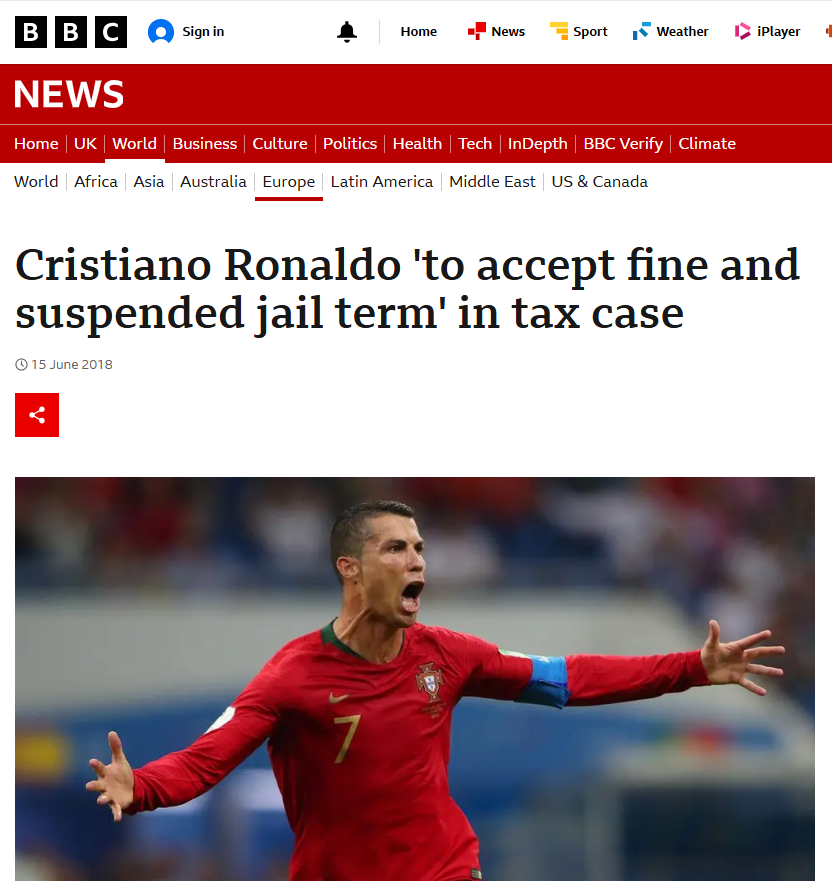
Cristiano Ronaldo admitted four tax offences involving approximately €5.7m. He received a 23-month prison sentence, served no time and accepted enormous financial consequences.
DROP IMAGE / QUOTE AFTER THIS PARAGRAPH
↕ DRAG IMAGE
€5.7M tax case lead to €18.8m fine to avoid jail time for Ronaldo
José Mourinho admitted two tax offences involving approximately €3.3m. He received an aggregate one-year prison sentence, served no time and accepted substantial financial penalties.
DROP IMAGE / QUOTE AFTER THIS PARAGRAPH
Alexis Sánchez admitted two offences involving approximately €983,000. He received a 16-month suspended sentence, served no time and repaid tax, interest and a substantial fine.
DROP IMAGE / QUOTE AFTER THIS PARAGRAPH
Radamel Falcao admitted offences involving approximately €5.66m. He received a 16-month prison sentence, financially substituted, together with substantial tax and financial penalties.
DROP IMAGE / QUOTE AFTER THIS PARAGRAPH
Samuel Eto'o admitted four offences involving approximately €3.8m. He received a 22-month suspended sentence, served no time and accepted substantial financial consequences.
DROP IMAGE / QUOTE AFTER THIS PARAGRAPH
Diego Costa admitted a tax offence involving more than €1m. He received a six-month prison sentence, served no time and paid substantial financial penalties.
DROP IMAGE / QUOTE AFTER THIS PARAGRAPH
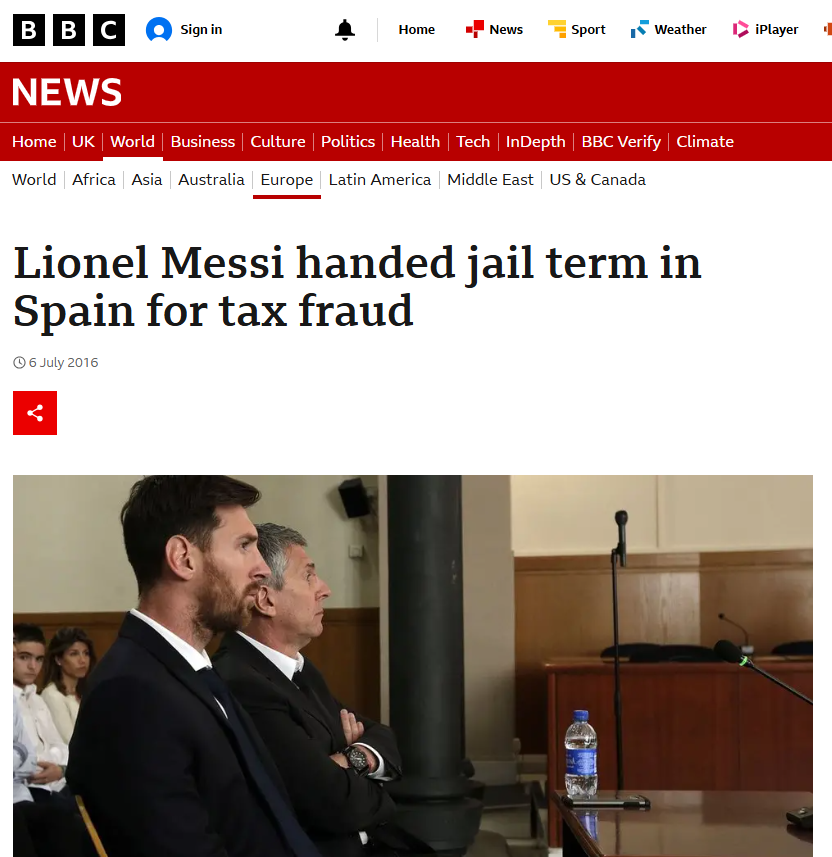
And then there is Lionel Messi.
DROP IMAGE / QUOTE AFTER THIS PARAGRAPH
↕ DRAG IMAGE
People understandably confuse "no time served" with "Out of court" settlement
Messi contested his prosecution. He was convicted after trial, his conviction was upheld by Spain's Supreme Court and he received a 21-month prison sentence and substantial fines. He still served no time.
DROP IMAGE / QUOTE AFTER THIS PARAGRAPH
The mechanisms aren't identical, so reducing all of these cases to wealthy footballers simply paying money to avoid prison would be inaccurate.
DROP IMAGE / QUOTE AFTER THIS PARAGRAPH
But the practical pattern is striking: **criminal conviction → formal custodial sentence → no actual imprisonment → very substantial financial consequences.**
DROP IMAGE / QUOTE AFTER THIS PARAGRAPH
Which brings us to Shakira.
DROP IMAGE / QUOTE AFTER THIS PARAGRAPH
↕ DRAG IMAGE
Headlines can be accurate and still misleading
Why Shakira's three years doesn't compare with Pozzo's twelve
DROP IMAGE / QUOTE AFTER THIS PARAGRAPH
Shakira's criminal case concerned tax years 2012, 2013 and 2014. She ultimately accepted six separate tax offences.
DROP IMAGE / QUOTE AFTER THIS PARAGRAPH
Her final headline sentence was: three years. Compared with Pozzo's twelve, that sounds like an enormous disparity.
DROP IMAGE / QUOTE AFTER THIS PARAGRAPH
But before Shakira reached her agreement, prosecutors were seeking eight years and two months' imprisonment and approximately €23.5m in fines.
DROP IMAGE / QUOTE AFTER THIS PARAGRAPH
She had repaid the approximately €14.5m disputed tax, subsequently paid interest and ultimately accepted criminal responsibility.
DROP IMAGE / QUOTE AFTER THIS PARAGRAPH
Strong mitigation for repairing the financial damage was applied.
DROP IMAGE / QUOTE AFTER THIS PARAGRAPH
Her eventual sentence became: six offences × six months = three years.****
DROP IMAGE / QUOTE AFTER THIS PARAGRAPH
Those sentences were financially substituted. She served zero days in prison.
DROP IMAGE / QUOTE AFTER THIS PARAGRAPH
So we're not really comparing: Shakira — 3 years Pozzo — 12 years
DROP IMAGE / QUOTE AFTER THIS PARAGRAPH
We're comparing: Shakira — prosecution originally sought 8 years 2 months → repayment + mitigation + agreement → 3 years nominal custody → zero actually served. with: Pozzo — prosecution currently seeks 12 years → trial hasn't started → outcome unknown.
DROP IMAGE / QUOTE AFTER THIS PARAGRAPH
One is the negotiated endpoint. The other is the prosecution's opening position.
DROP IMAGE / QUOTE AFTER THIS PARAGRAPH
What does “doing a deal” actually mean? This is where British terminology becomes dangerous.
DROP IMAGE / QUOTE AFTER THIS PARAGRAPH
An “out-of-court settlement” normally sounds like a dispute being resolved without criminal liability being determined.
DROP IMAGE / QUOTE AFTER THIS PARAGRAPH
Spanish tax law does contain a mechanism through which somebody who fully regularises their tax position sufficiently early can potentially avoid criminal prosecution.
DROP IMAGE / QUOTE AFTER THIS PARAGRAPH
But that opportunity comes before the case has reached anything resembling Pozzo's present position.
DROP IMAGE / QUOTE AFTER THIS PARAGRAPH
A criminal conformidad now would be very different - it is much closer to a negotiated guilty plea.
DROP IMAGE / QUOTE AFTER THIS PARAGRAPH
The defendant accepts the agreed factual and criminal basis.The court approves the agreement and imposes sentence. There is a criminal conviction.
DROP IMAGE / QUOTE AFTER THIS PARAGRAPH
So: Regularise sufficiently early → potentially no criminal prosecution or conviction. Conformidad once criminal proceedings are underway → negotiated punishment, but conviction.
DROP IMAGE / QUOTE AFTER THIS PARAGRAPH
Consequently, if we eventually read:
DROP IMAGE / QUOTE AFTER THIS PARAGRAPH
“Gino Pozzo does a deal with the Spanish taxman”
DROP IMAGE / QUOTE AFTER THIS PARAGRAPH
the sensible response isn't immediately: How much did he pay? It is: What sort of deal?
DROP IMAGE / QUOTE AFTER THIS PARAGRAPH
Shakira provides another warning
DROP IMAGE / QUOTE AFTER THIS PARAGRAPH
In May 2026, Shakira won a separate Spanish tax case concerning 2011.
DROP IMAGE / QUOTE AFTER THIS PARAGRAPH
The Audiencia Nacional concluded that the authorities hadn't established the required Spanish tax residence for that year.
DROP IMAGE / QUOTE AFTER THIS PARAGRAPH
That did not overturn her criminal convictions concerning 2012–14.
DROP IMAGE / QUOTE AFTER THIS PARAGRAPH
Different years. Different cases.
DROP IMAGE / QUOTE AFTER THIS PARAGRAPH
So both statements are true:
DROP IMAGE / QUOTE AFTER THIS PARAGRAPH
Shakira was convicted of six Spanish tax offences. Shakira subsequently defeated the Spanish tax authorities in court.
DROP IMAGE / QUOTE AFTER THIS PARAGRAPH
↕ DRAG IMAGE
One possible outcome from many - but what does it mean beneath the headlines?
It is a perfect illustration of why reading the headline without understanding the underlying proceeding can create a completely false impression.
Convicted, Acquitted or a Deal? Why Previous Club Owners Don't Give Us the Answer
If celebrity cases explain Spanish tax sentencing, perhaps football-club owners can tell us what will happen to Pozzo.
DROP IMAGE / QUOTE AFTER THIS PARAGRAPH
Unfortunately, they tell us almost exactly the opposite. There is no single pattern.
DROP IMAGE / QUOTE AFTER THIS PARAGRAPH
**Manuel Ruiz de Lopera — Real Betis**
DROP IMAGE / QUOTE AFTER THIS PARAGRAPH
↕ DRAG IMAGE
Manuel Ruiz de Lopera
Former Betis president and controlling shareholder Manuel Ruiz de Lopera faced corporation-tax offences arising from financial arrangements involving Betis.
DROP IMAGE / QUOTE AFTER THIS PARAGRAPH
He eventually reached an agreement and accepted criminal responsibility. He received two custodial sentences of approximately seven and a half months each but didn't serve them.
DROP IMAGE / QUOTE AFTER THIS PARAGRAPH
The practical consequences became overwhelmingly financial. That looks rather like the outcome many people instinctively imagine for Pozzo:
DROP IMAGE / QUOTE AFTER THIS PARAGRAPH
agreement → conviction → nominal prison sentence → substantial financial consequences → no actual prison.
DROP IMAGE / QUOTE AFTER THIS PARAGRAPH
Then there is Teresa Rivero.
DROP IMAGE / QUOTE AFTER THIS PARAGRAPH
↕ DRAG IMAGE
Teresa Rivero
**** — Rayo Vallecano
DROP IMAGE / QUOTE AFTER THIS PARAGRAPH
Former Rayo president Teresa Rivero was convicted of four tax offences involving approximately €8.4m.
DROP IMAGE / QUOTE AFTER THIS PARAGRAPH
She received an aggregate seven-year prison sentence, together with substantial financial penalties and liability for the unpaid tax. Her conviction was upheld by Spain's Supreme Court.
DROP IMAGE / QUOTE AFTER THIS PARAGRAPH
So the proposition that Spanish football owners convicted of tax offences inevitably receive nominal sentences and write a cheque doesn't survive contact with the evidence.
DROP IMAGE / QUOTE AFTER THIS PARAGRAPH
**Fernando Roig — Villarreal**
DROP IMAGE / QUOTE AFTER THIS PARAGRAPH
↕ DRAG IMAGE
Fernando Roig
Then we have a third route.
DROP IMAGE / QUOTE AFTER THIS PARAGRAPH
Villarreal president **** was convicted of tax offences and false documentation connected with construction work at Villarreal's stadium and training complex.
DROP IMAGE / QUOTE AFTER THIS PARAGRAPH
He received a sentence approaching one year but on 24 September 2026, the conviction was overturned on appeal.
DROP IMAGE / QUOTE AFTER THIS PARAGRAPH
The appeal court concluded that the evidence wasn't sufficient to establish that Roig knew about the false-invoicing scheme underlying the offences.
DROP IMAGE / QUOTE AFTER THIS PARAGRAPH
Three club figures. Three different endings:
DROP IMAGE / QUOTE AFTER THIS PARAGRAPH
Lopera — agreement and conviction.
DROP IMAGE / QUOTE AFTER THIS PARAGRAPH
Rivero — conviction and substantial imprisonment.
DROP IMAGE / QUOTE AFTER THIS PARAGRAPH
Roig — conviction followed by acquittal on appeal.
DROP IMAGE / QUOTE AFTER THIS PARAGRAPH
That's why previous cases can't responsibly be converted into a prediction for Pozzo.
DROP IMAGE / QUOTE AFTER THIS PARAGRAPH
And then, just before the trial, Quique Pina****
DROP IMAGE / QUOTE AFTER THIS PARAGRAPH
↕ DRAG IMAGE
Quique Pina
On 28 September 2026, the Audiencia Nacional convicted former Granada president Quique Pina of five separate tax offences concerning his personal income between 2012 and 2016.
DROP IMAGE / QUOTE AFTER THIS PARAGRAPH
The court found approximately €2.86m in unpaid tax and imposed an aggregate two-and-a-half-year prison sentence, together with approximately €1.4m in fines and repayment of the tax.
DROP IMAGE / QUOTE AFTER THIS PARAGRAPH
Mitigation was applied because of excessive delays in the proceedings. Pina has appealed.
DROP IMAGE / QUOTE AFTER THIS PARAGRAPH
This is not the same case as the forthcoming Granada corporation-tax trial. Pina's conviction doesn't establish Pozzo's guilt. Nor is there credible evidence that I've found suggesting Pina has agreed to cooperate with prosecutors against Pozzo.
DROP IMAGE / QUOTE AFTER THIS PARAGRAPH
But the chronology is striking.
DROP IMAGE / QUOTE AFTER THIS PARAGRAPH
↕ DRAG IMAGE
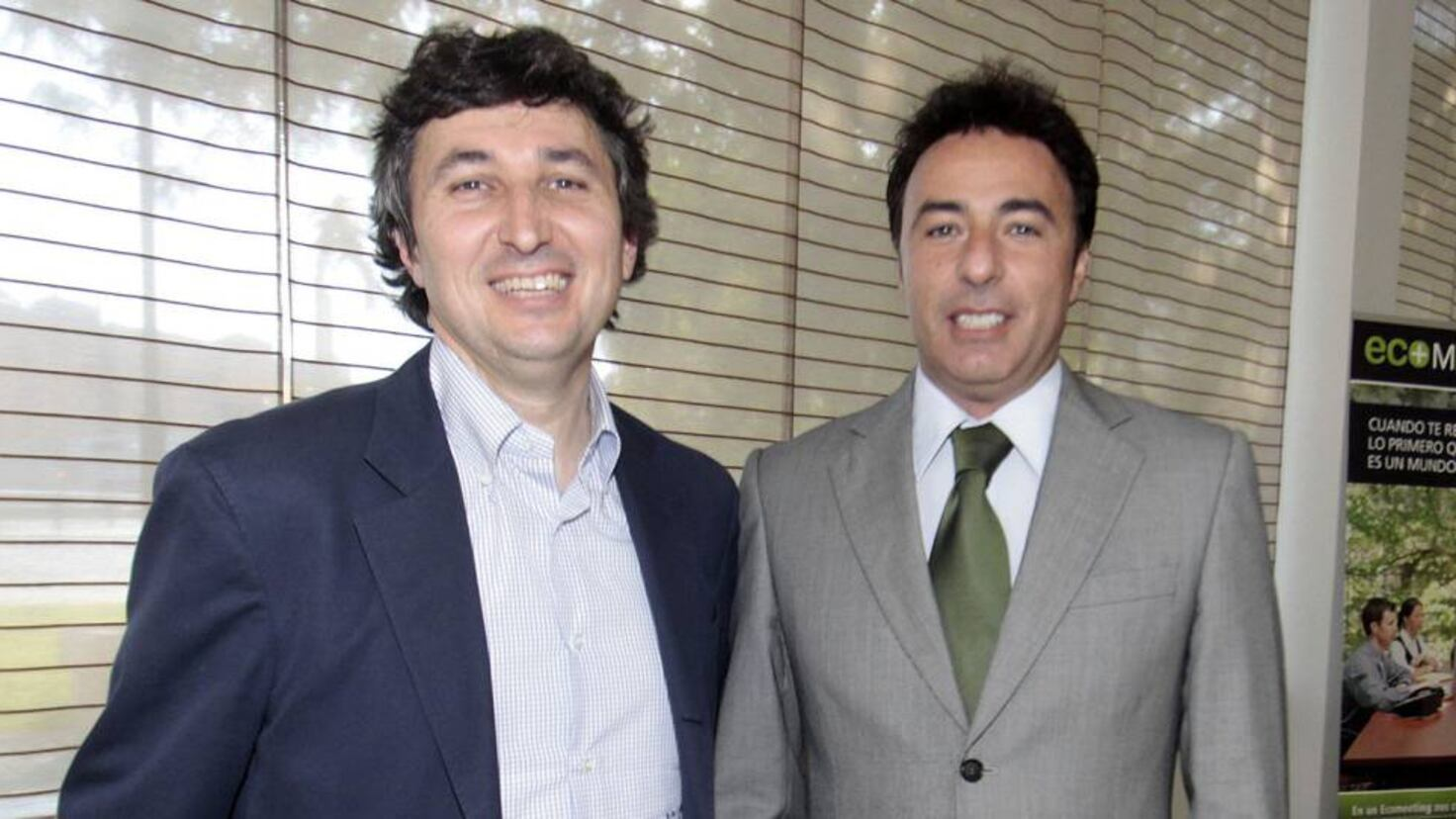
Gino Pozzo and Quique Pina
Pina's offences cover: 2012–16.
DROP IMAGE / QUOTE AFTER THIS PARAGRAPH
The Granada corporation-tax allegations cover: 2013–15.
DROP IMAGE / QUOTE AFTER THIS PARAGRAPH
And there is a conceptual overlap.
DROP IMAGE / QUOTE AFTER THIS PARAGRAPH
The court in Pina's case concluded that income from his football activities had been channelled through companies and subjected to corporation tax when it properly belonged within his personal income-tax liability.
DROP IMAGE / QUOTE AFTER THIS PARAGRAPH
Once again, the question wasn't simply:
DROP IMAGE / QUOTE AFTER THIS PARAGRAPH
Was tax paid? It was:
DROP IMAGE / QUOTE AFTER THIS PARAGRAPH
Who actually earned the income and therefore who should have paid the tax? Which brings us neatly back to the central argument over Fifteen.
Why a Spanish Tax Trial Could Become a Watford Ownership Story
Until now this has largely been a Spanish story. This final part is where it comes home to Vicarage Road.
DROP IMAGE / QUOTE AFTER THIS PARAGRAPH
Granada, Udinese and Watford
DROP IMAGE / QUOTE AFTER THIS PARAGRAPH
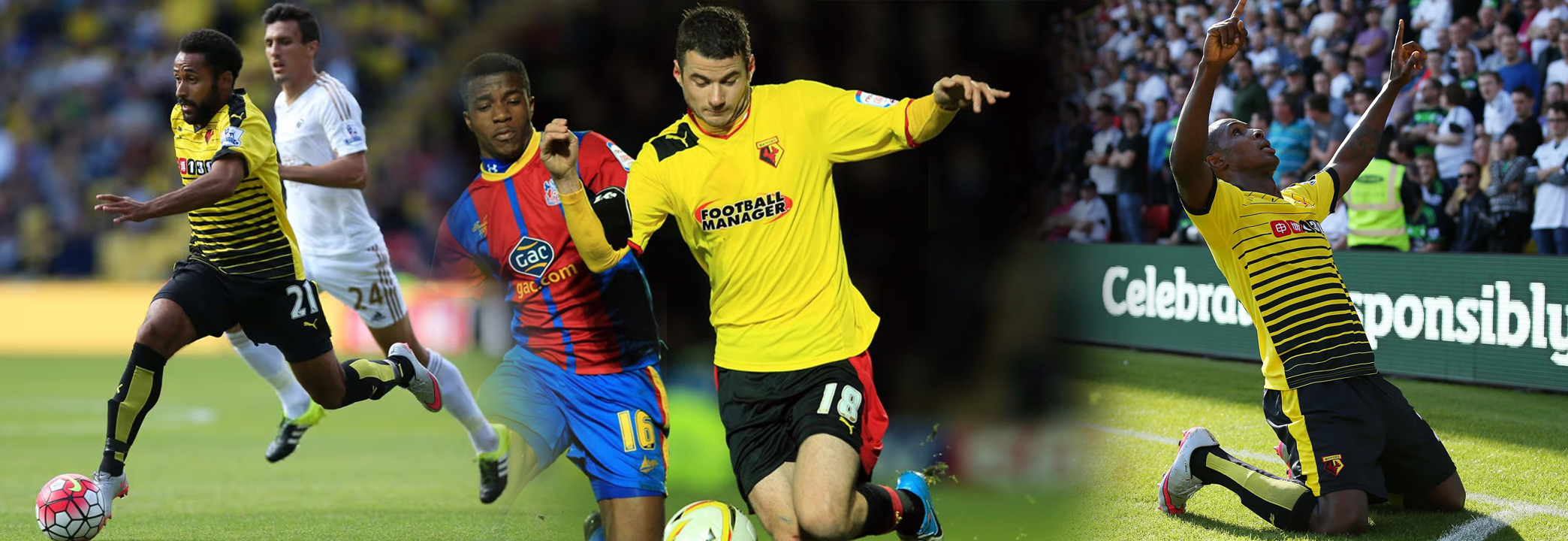
The relationship between Granada, Udinese and Watford was hardly secret. It was one of the obvious attractions of the Pozzo multi-club model. Ikechi Anya and Daniel Pudil moved from Granada to Watford. Odion Ighalo played for Udinese and Granada before becoming one of Watford's most successful strikers of the modern era.Watford signed Abdoulaye Doucouré and immediately loaned him to Granada.
DROP IMAGE / QUOTE AFTER THIS PARAGRAPH
↕ DRAG IMAGE
ANya, Pudil & Ighalo
There is nothing inherently suspicious about any of that.
DROP IMAGE / QUOTE AFTER THIS PARAGRAPH
Spanish investigators did, however, examine financial relationships across the clubs and referred during the investigation to Granada, Udinese and Watford as a “triángulo mercantil” — commercial triangle.
DROP IMAGE / QUOTE AFTER THIS PARAGRAPH
That shouldn't be stretched beyond the evidence. The existence of a multi-club network doesn't demonstrate tax fraud.
DROP IMAGE / QUOTE AFTER THIS PARAGRAPH
Nor does the Granada prosecution establish that ordinary Watford player transactions were unlawful. But one individual does provide a direct personnel connection.
DROP IMAGE / QUOTE AFTER THIS PARAGRAPH
Raffaele Riva
DROP IMAGE / QUOTE AFTER THIS PARAGRAPH
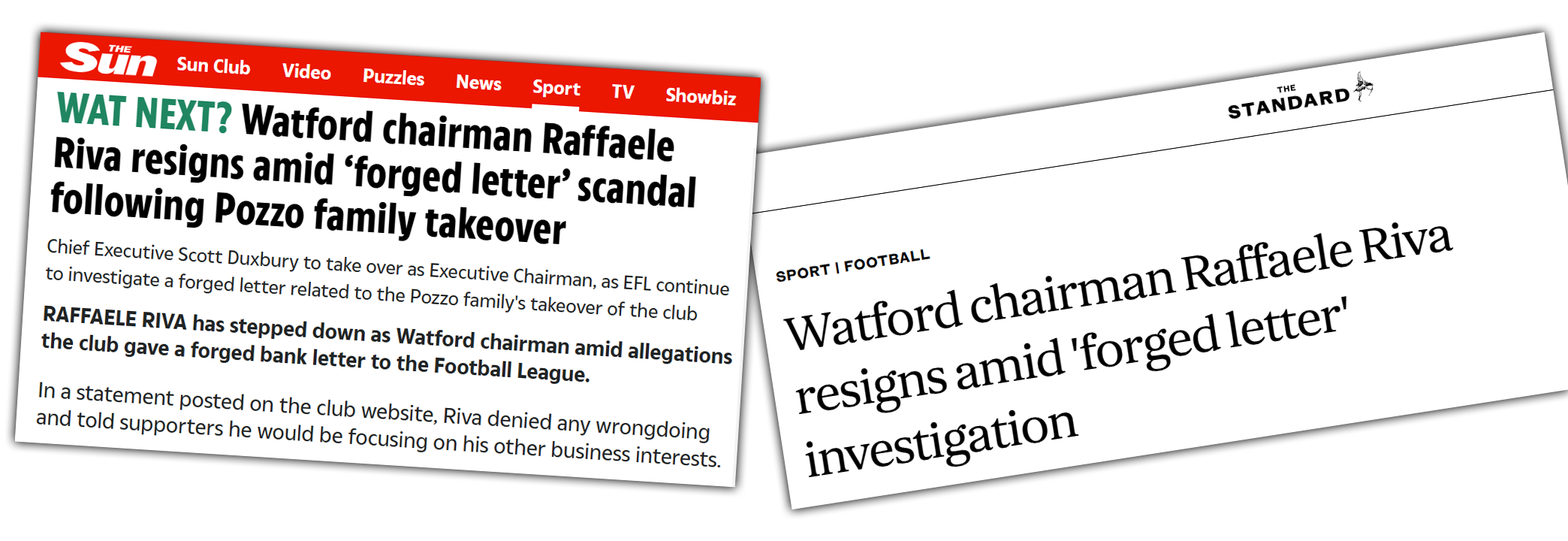
Raffaele Riva represented Fifteen in arrangements with Granada. He subsequently became a Watford director following the Pozzo takeover and eventually served as executive chairman.
DROP IMAGE / QUOTE AFTER THIS PARAGRAPH
So an individual involved in the Luxembourg financing arrangements now being examined in Spain also occupied one of the most senior positions at Watford. That doesn't demonstrate wrongdoing at Watford.
DROP IMAGE / QUOTE AFTER THIS PARAGRAPH
But neither are the two stories completely disconnected.
DROP IMAGE / QUOTE AFTER THIS PARAGRAPH
Riva subsequently became central to another Watford regulatory episode when falsified banking documentation was supplied during an EFL process concerning the club.
DROP IMAGE / QUOTE AFTER THIS PARAGRAPH
↕ DRAG IMAGE
Riva banned over finance letter forgery
Riva accepted responsibility for the regulatory breach, was fined and indefinitely suspended from acting as a Relevant Person at an EFL club.
DROP IMAGE / QUOTE AFTER THIS PARAGRAPH
Again, that proves nothing about the Spanish tax allegations. It simply explains why his appearance in both stories is relevant.
DROP IMAGE / QUOTE AFTER THIS PARAGRAPH
Why conviction could matter more than prison
DROP IMAGE / QUOTE AFTER THIS PARAGRAPH
Suppose Pozzo ultimately received an outcome superficially resembling Ronaldo or Shakira:
DROP IMAGE / QUOTE AFTER THIS PARAGRAPH
conviction + nominal prison sentence + enormous financial penalty + zero actual imprisonment.
DROP IMAGE / QUOTE AFTER THIS PARAGRAPH
Would that mean nothing had changed at Watford? Not necessarily.
DROP IMAGE / QUOTE AFTER THIS PARAGRAPH
English football regulation doesn't simply ask whether somebody physically entered a prison.
DROP IMAGE / QUOTE AFTER THIS PARAGRAPH
The EFL Owners' and Directors' Test contains defined Disqualifying Events, including relevant fraud and dishonesty convictions, and recognises equivalent circumstances arising overseas.
DROP IMAGE / QUOTE AFTER THIS PARAGRAPH
And there is already a remarkably relevant precedent.
DROP IMAGE / QUOTE AFTER THIS PARAGRAPH
**Massimo Cellino**
DROP IMAGE / QUOTE AFTER THIS PARAGRAPH
↕ DRAG IMAGE
Massimo Cellino - banned owner
Former Leeds United owner **Massimo Cellino** was convicted in Italy of tax evasion relating to import duty on a yacht. The Football League obtained the Italian court's judgment and concluded that his conduct involved dishonesty for the purposes of its Owners' and Directors' Test.
DROP IMAGE / QUOTE AFTER THIS PARAGRAPH
Cellino was disqualified. His appeal failed.
DROP IMAGE / QUOTE AFTER THIS PARAGRAPH
That doesn't mean: Pozzo conviction = automatic disqualification.
DROP IMAGE / QUOTE AFTER THIS PARAGRAPH
Different case. Different facts. And the regulatory landscape has changed.
DROP IMAGE / QUOTE AFTER THIS PARAGRAPH
But Cellino establishes that a foreign tax conviction can have consequences for somebody controlling an English Football League club.
DROP IMAGE / QUOTE AFTER THIS PARAGRAPH
And now there is another regulator
DROP IMAGE / QUOTE AFTER THIS PARAGRAPH
Since May 2026, the Independent Football Regulator's regime has operated alongside the EFL's system. Its suitability regime considers matters including honesty, integrity, criminal history and regulatory conduct when assessing owners and significant decision-makers.
DROP IMAGE / QUOTE AFTER THIS PARAGRAPH
That potentially changes the question Watford supporters should ultimately be asking.
DROP IMAGE / QUOTE AFTER THIS PARAGRAPH
Not simply: Will Gino Pozzo go to prison? But: Will Gino Pozzo be convicted — and precisely what will the Spanish judgment say he did?
DROP IMAGE / QUOTE AFTER THIS PARAGRAPH
That doesn't mean conviction automatically produces an immediate forced sale of Watford.
DROP IMAGE / QUOTE AFTER THIS PARAGRAPH
The precise offence, findings of the Spanish court, appeal status and application of English regulatory rules would all matter. But equally: No prison doesn't necessarily mean no consequences.
DROP IMAGE / QUOTE AFTER THIS PARAGRAPH
So what should we actually watch for?
DROP IMAGE / QUOTE AFTER THIS PARAGRAPH
When the trial begins on 9 November, there will inevitably be headlines. Understanding their terminology will matter.
DROP IMAGE / QUOTE AFTER THIS PARAGRAPH
“Prosecutors seek 12 years.” That means four years requested for each of three alleged aggravated offences. It doesn't mean Pozzo has been sentenced to twelve years.
DROP IMAGE / QUOTE AFTER THIS PARAGRAPH
“Pozzo pays the Spanish tax authorities.” That doesn't necessarily tell us whether he has been convicted.
DROP IMAGE / QUOTE AFTER THIS PARAGRAPH
“Pozzo reaches a settlement.” That isn't enough either. • Was it a conformidad? • What facts were accepted? • What offences were admitted? • What sentence was imposed? • Was there a criminal conviction?
DROP IMAGE / QUOTE AFTER THIS PARAGRAPH
Conversely: “Pozzo goes to trial.” That doesn't mean conviction is inevitable. The prosecution still has to establish its case. And the substantive dispute may ultimately be considerably more interesting than the spectacular prison figures.
DROP IMAGE / QUOTE AFTER THIS PARAGRAPH
The prosecution says Granada's profits were artificially moved to Luxembourg.
DROP IMAGE / QUOTE AFTER THIS PARAGRAPH
The defence says Fifteen provided genuine capital, assumed genuine investment risk and legitimately owned economic interests entitling it to those returns.
DROP IMAGE / QUOTE AFTER THIS PARAGRAPH
The evidence may ultimately come down to contracts, accounts, bank transfers, allocation of investment risk, ownership and control, what happened when investments failed rather than succeeded — and potentially exactly what the Spanish Tax Agency was told in 2012.
DROP IMAGE / QUOTE AFTER THIS PARAGRAPH
Nobody outside the proceedings knows how the court will answer those questions. Pozzo could be acquitted. He could be convicted of some or all of the allegations. There could eventually be a conformidad. There could be appeals.
DROP IMAGE / QUOTE AFTER THIS PARAGRAPH
Previous cases demonstrate all of those possibilities rather than identifying one as the likely outcome. What they allow us to do is understand what the result means when it eventually arrives.
DROP IMAGE / QUOTE AFTER THIS PARAGRAPH
Because if the eventual headline reads: “Gino Pozzo does a deal with the Spanish taxman” that might sound to British ears like the settlement of a financial dispute.
DROP IMAGE / QUOTE AFTER THIS PARAGRAPH
Depending upon precisely what happened, it could instead mean a criminal conviction and agreed sentence — followed by an entirely new set of questions about Watford Football Club.
DROP IMAGE / QUOTE AFTER THIS PARAGRAPH
Or there may be no deal at all.
DROP IMAGE / QUOTE AFTER THIS PARAGRAPH
In which case the court may ultimately have to answer the question with which this special began:
DROP IMAGE / QUOTE AFTER THIS PARAGRAPH
Were Granada's profits artificially moved to Luxembourg — or was Luxembourg where genuine investment returns properly belonged?
DROP IMAGE / QUOTE AFTER THIS PARAGRAPH
Don't predict the headline but know how to read it.
Article 305 bis of the Spanish Criminal Code provides an increased sentence of two to six years' imprisonment and a fine of two to six times the amount defrauded when any of three aggravating circumstances applies. BOE
DROP IMAGE / QUOTE AFTER THIS PARAGRAPH
1. The amount defrauded exceeds €600,000. This is directly relevant to Granada because each of the three annual sums alleged by prosecutors exceeds €600,000.
DROP IMAGE / QUOTE AFTER THIS PARAGRAPH
2. The fraud is committed within an organisation or criminal group.
DROP IMAGE / QUOTE AFTER THIS PARAGRAPH
3. Concealment structures are used. This covers the use of interposed individuals or companies, entities without legal personality, fiduciary arrangements, tax havens or zero-tax territories where their use conceals or makes it difficult to determine the identity of the taxpayer or offender, the amount defrauded, or the assets of the taxpayer or offender. BOE
DROP IMAGE / QUOTE AFTER THIS PARAGRAPH
That final provision requires an important qualification in the Granada context:
DROP IMAGE / QUOTE AFTER THIS PARAGRAPH
Using a Luxembourg company isn't itself an aggravating circumstance. The issue is whether such a structure was used in the manner specified by the legislation to conceal or impede determination of those matters. For the Granada allegations, however, prosecutors already have a straightforward route to alleging aggravated offences through the amount involved:
DROP IMAGE / QUOTE AFTER THIS PARAGRAPH
2013 — €635,000 2014 — €5.915m 2015 — €2.892m
DROP IMAGE / QUOTE AFTER THIS PARAGRAPH
Each annual allegation independently exceeds the statutory €600,000 threshold.
DROP IMAGE / QUOTE AFTER THIS PARAGRAPH
That is why prosecutors can allege three aggravated tax offences — and why requesting four years for each produces the headline figure of 12 years.